
The Trump administration has taken the unusual step of intervening in an environmental lawsuit against Elon Musk’s AI company xAI, arguing that the data centre at the centre of the dispute is so important to national security that it should be protected from legal action seeking to restrict its power supply.
Dilemma
The case highlights a growing sustainability dilemma facing the AI industry. For example, while artificial intelligence is increasingly being positioned as a tool for solving global challenges, its rapidly growing appetite for electricity is creating new environmental pressures, particularly as operators race to build ever-larger data centres.
Why The Government Has Intervened
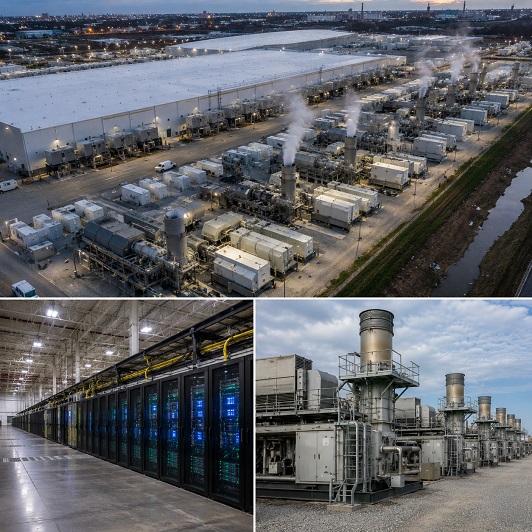
The dispute in the U.S. centres on xAI’s Colossus AI facility in Mississippi, which relies on dozens of methane gas turbines to help power the infrastructure used to train and operate Grok, the company’s AI model.
The National Association for the Advancement of Colored People (NAACP), one of the oldest and largest civil rights organisations in the United States, filed the lawsuit. In this case, the NAACP’s Mississippi State Conference filed it. The lawsuit alleges that the turbines are operating without the permits required under the Clean Air Act and are contributing to air pollution that could affect nearby communities.
However, in a court filing submitted on behalf of the United States government, the Department of Justice argued that the lawsuit threatens “American national, economic, and energy security by seeking to shut off the power supply for artificial-intelligence innovation that supports the Department of War’s military operations.”
The filing seeks dismissal of the case and represents an unusually direct intervention by the federal government in support of a private technology company.
Why Grok Is Being Treated As A Strategic Asset
A key part of the government’s argument is that Grok has become integrated into sensitive national security operations. For example, according to a declaration submitted by Cameron Stanley, Chief Digital and Artificial Intelligence Officer at the Department of War (previously known as the Department of Defense), xAI’s Grok is “one of only four proprietary state-of-the-art (‘frontier’) AI models currently capable of supporting national security applications”.
The declaration also states that the Department relies on a specialised version known as Grok Gov Model and that it provides capabilities “found in no other frontier AI model”.
The filing claims that if the Mississippi facility were unable to continue operating at its current scale, the development and improvement of future Grok models could be affected, potentially impacting military and intelligence capabilities.
Whether or not the court ultimately accepts those arguments, the case demonstrates how rapidly advanced AI systems are being reclassified from commercial technology platforms into infrastructure that governments increasingly view as strategically important.
The Environmental Cost Of AI Growth
The environmental concerns at the heart of the case are difficult to ignore. For example, the turbines reportedly emit pollutants including nitrogen oxides and particulate matter, both of which have been linked to respiratory and cardiovascular health problems. Environmental groups argue that communities living near the facility should not bear the environmental cost of powering AI systems.
Also, the growth of AI is creating unprecedented demand for electricity. Modern AI models require vast numbers of processors working simultaneously, and those processors need enormous amounts of power.
The result is that many technology companies are now competing for access to electricity on a scale more commonly associated with heavy industry.
This creates an uncomfortable contradiction. Many of the same companies investing heavily in sustainability initiatives and clean technologies are simultaneously searching for whatever energy sources can support their rapidly expanding AI ambitions.
The Search For Cleaner Alternatives
The controversy also highlights why technology companies and investors are increasingly searching for lower-carbon energy sources capable of supporting AI’s growing power demands. One recent example is Critical Energy, a startup founded by a former SpaceX engineer that has raised $22 million to develop modular geothermal turbines for geothermal power plants. The company argues that geothermal energy could provide reliable, round-the-clock electricity for energy-hungry AI infrastructure years before many advanced nuclear projects become commercially available.
Projects such as these are attracting growing attention because geothermal energy can provide continuous power without the intermittency associated with solar or wind generation.
For the AI industry, that matters because data centres require power around the clock, making reliability almost as important as sustainability.
The challenge, however, is that many cleaner energy projects take years to deploy, while AI demand is growing today.
What Does This Mean For Your Organisation?
This case essentially offers an early glimpse of a debate that is likely to become increasingly common over the next decade. Governments want to lead in AI. Businesses want access to more powerful AI tools. At the same time, communities, regulators, and environmental groups are demanding that growth happens responsibly, and the lawsuit against xAI sits directly at the intersection of those competing priorities.
For organisations investing in AI, the wider lesson is that sustainability is becoming an infrastructure issue as much as a software issue. Questions about where AI runs, how it is powered, and what environmental impacts it creates are likely to become increasingly important alongside discussions about capability, productivity, and security.
The case also suggests that some governments are beginning to treat advanced AI infrastructure in much the same way as power stations, telecommunications networks, and defence assets. If that trend continues, future debates about AI may focus as much on energy policy and environmental impact as they do on the technology itself.
The political backdrop is also difficult to overlook in this particular case. Given Elon Musk’s close relationship with the Trump administration, some critics are likely to question whether the government’s intervention reflects purely national security concerns or whether political considerations may also have played a role. The administration maintains that its position is based on the strategic importance of the AI infrastructure involved.
The outcome of this particular lawsuit remains uncertain at this point. What is already clear, however, is that the race to build more powerful AI systems is creating difficult choices between economic growth, national security, environmental protection, and sustainable energy development, choices that governments, businesses, and communities will increasingly be forced to confront.