
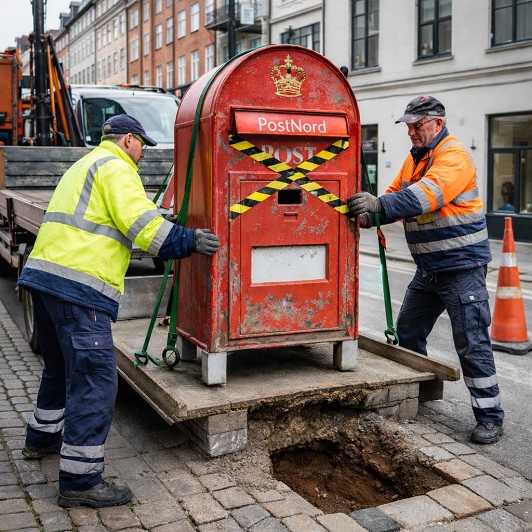
PostNord delivered its final letter in Denmark on 30 December 2025, bringing an end to more than four centuries of nationwide letter delivery after letter volumes collapsed as most communication moved online.
Just Parcels Now
For the first time since organised postal services were established in Denmark in 1624, the country’s historic national operator no longer delivers domestic letters. From 2026, PostNord says it will now operate in Denmark solely as a parcel carrier, thereby reflecting a structural change in how Danes communicate, receive official information, and interact with public and private services.
A Decision Rooted in Long-Term Decline
PostNord’s decision was not driven by a sudden policy shift but by a sustained and dramatic collapse in letter volumes over the past 25 years. For example, according to figures published by the company, the number of letters handled by PostNord Denmark has fallen by more than 90 per cent since 2000, with volumes continuing to decline rapidly year on year.
In its official announcement, PostNord stated: “Danes have become more and more digital, and what was once sent by letter is now received digitally by the vast majority of people.” The company added that letter volumes “have decreased by over 90 per cent since 2000, and the volume of letters continues to decrease rapidly”.
The pace of decline has accelerated in recent years. PostNord executives have noted that letter volumes fell by around 30 per cent in a single year leading up to the decision, underlining how quickly physical mail has been displaced by digital alternatives.
Denmark’s Digital-First Society
Denmark’s status as one of the world’s most digitalised countries helps explain why the move became unavoidable. Most official communications from public authorities are delivered through Digital Post, an electronic mailbox linked to MitID, Denmark’s national digital identity system. MitID is used for everything from online banking and tax returns to healthcare appointments and document signing.
In fact, around 95 per cent of Danes now receive official correspondence digitally, with only a small minority opting out. As a result, physical letters have increasingly become an exception rather than a default channel, mainly used for niche purposes, formal notifications, or correspondence with people who are exempt from digital systems.
PostNord acknowledged this reality directly, stating that “the letter market is no longer profitable” under current conditions, making continued nationwide letter delivery unsustainable.
From Universal Service to Competitive Market
Denmark’s postal landscape has also changed at a regulatory level. For example, until the end of 2023, the country operated a universal postal service model, under which PostNord was required to deliver letters nationwide at regulated prices. This system ended with the introduction of a new Postal Act in 2024.
The updated legislation opened the letter market to full competition and removed VAT exemptions on letters, pushing up postage prices. At the time of PostNord’s announcement, sending a standard letter could cost as much as 29 Danish krone, making physical mail significantly more expensive relative to digital communication.
PostNord’s managing director in Denmark, Kim Pedersen, has said publicly that higher prices further reduced demand, reinforcing a downward spiral that left letter delivery commercially unviable.
What Changed in 2025?
Throughout 2025, PostNord continued to deliver letters as normal while preparing for its exit. Clear deadlines were set to give households and businesses time to adjust. For example:
– Basic letters, including business letters, direct mail, and magazines, had to be handed in by 18 December 2025.
– More specialised services such as registered letters and letters with return receipt remained available until 29 December.
– The final deliveries took place on 30 December 2025.
Refunds
PostNord also confirmed that postal labels purchased in 2024 or 2025 would be eligible for refunds during a limited period in 2026 if unused, stating: “We’ve made sure that all postal labels purchased in 2024 – or to be purchased in 2025 – can be refunded for a limited time in 2026 if you don’t use them in 2025.”
The Disappearance of the Red Postboxes
One of the most visible consequences of the decision was the removal of Denmark’s iconic red postboxes. From 1 June 2025, PostNord began dismantling the country’s remaining 1,500 mailboxes, with all removals completed by the end of the year.
Each postbox was clearly marked in advance with its planned removal date, and boxes could still be used until taken out of service. PostNord also said it was working to ensure that the postboxes would “have a new purpose” once removed, rather than being discarded.
The removal programme symbolised the practical end of everyday letter posting for most Danes and marked a clear shift away from street-level postal infrastructure.
Impact on Jobs and Operations
The move away from letters had significant workforce implications. For example, around 1,500 jobs were affected in Denmark, out of a total PostNord workforce of roughly 4,600 in the country. While PostNord continues to operate in parcels, letter sorting, delivery, and associated logistics roles were no longer required at previous levels.
PostNord has faced financial pressure for several years, with letter delivery becoming increasingly loss-making as volumes fell and fixed costs remained high.
PostNord Still Operating In Sweden
Importantly, the decision applies only to Denmark. PostNord’s letter operations in Sweden continue unchanged, and the company remains active in the letter market there under different regulatory and market conditions.
Who Delivers Letters Now?
From 1 January 2026, the responsibility for letter delivery has shifted to other operators in the open market, most notably DAO, which already delivered letters prior to PostNord’s exit.
DAO has expanded its operations to handle significantly higher volumes, with customers required to drop letters at designated shops or pay for home collection services. According to Danish law, the option to send physical letters must continue to exist, meaning the government is obliged to ensure that alternative providers remain available.
What About International Mail?
International mail remains a bit of a transitional issue. PostNord was appointed by Denmark’s Ministry of Transport to handle international letters until 31 December 2025. However, responsibility for this service from 2026 onwards is expected to be determined through a separate process.
Groups Most Affected
While the vast majority of Danes rely on digital communication, the end of PostNord’s letter service has raised concerns for groups that still depend on physical mail. For example, advocacy organisations for older people have warned that hospital appointments, care decisions, and other important communications can still arrive by letter for those exempt from Digital Post.
PostNord acknowledged that physical letters will continue to be delivered by other operators, but critics have highlighted that alternative services often require digital payment or app-based interaction, which may present barriers for some users.
A Strategic Move to Parcels
At the centre of PostNord’s decision is a clear strategic refocus. As letter volumes collapsed, parcel deliveries surged due to sustained growth in online shopping. PostNord has said its goal from 2026 is “to become the Danes’ preferred parcel courier”.
In its announcement, the company explained: “We want to be the very best where Danes need us – and that’s in parcels.” The shift aligns PostNord with broader trends across Europe, where national postal operators are increasingly repositioning themselves as logistics and e-commerce delivery companies rather than traditional mail carriers.
The First To Go
The Danish case stands out for the scale and finality of the change. While many European postal services have reduced letter frequency or raised prices, Denmark is the first country to formally conclude that nationwide letter delivery is no longer economically or operationally viable in a fully digital society.
The implications of that decision continue to unfold, both within Denmark and across a continent facing similar pressures on long-established postal systems.
What Does This Mean For Your Business?
Denmark’s decision to end nationwide letter delivery marks a clear acknowledgement that physical mail has moved from being an essential public service to a marginal one in highly digital societies. PostNord’s withdrawal was not driven by sentiment or short-term pressures, but by structural changes in how information is created, distributed, and received. Once most official, financial, and personal communication shifted online, the economics of maintaining a universal letter network no longer held up, even for a long-established national operator.
For businesses, the Danish experience underlines how quickly legacy communication channels can become commercially unviable once digital alternatives reach critical mass. Organisations that still rely on physical letters for billing, notifications, or formal correspondence have been forced to adapt, either by moving processes online or by paying significantly higher costs through alternative providers. This transition has been manageable in Denmark largely because digital infrastructure, digital identity systems, and public adoption were already well established before the postal network was scaled back.
There are clear lessons here for UK businesses and public sector bodies. While the UK remains far more reliant on physical post than Denmark, letter volumes continue to decline, and postal operators are under increasing financial strain. The Danish case shows that once digital communication becomes the default for government and commerce, postal services tend to follow demand rather than tradition. UK organisations may, therefore, need to reassess how dependent they remain on physical mail, particularly for time-sensitive or high-volume communications, and whether existing processes are resilient to future changes in postal service provision or pricing.
Also, the Danish experience highlights the importance of managing transitions carefully for those who cannot easily move online. For example, older people, digitally excluded groups, and organisations that still require physical documentation remain stakeholders in any postal system, even as volumes fall. Ensuring that alternatives remain accessible, affordable, and legally compliant has become a policy challenge rather than a purely operational one.
Denmark’s move does not mean the end of letters altogether, but it does demonstrate that nationwide letter delivery is no longer guaranteed in societies where digital communication dominates. For postal operators, governments, businesses, and citizens alike, the shift marks a practical redefinition of what postal services are for in a digital-first economy, and who they are ultimately designed to serve.